
If you’re only using the hyphen, you’re oh-so-wrong
Hi! Happy Tuesday!
This week, we’re taking on a surprisingly controversial topic—the em dash.
First of all. Did you know there’s more than one kind of dash?
there’s the hyphen -
the slightly longer en dash –
and the “suspicious” em dash —
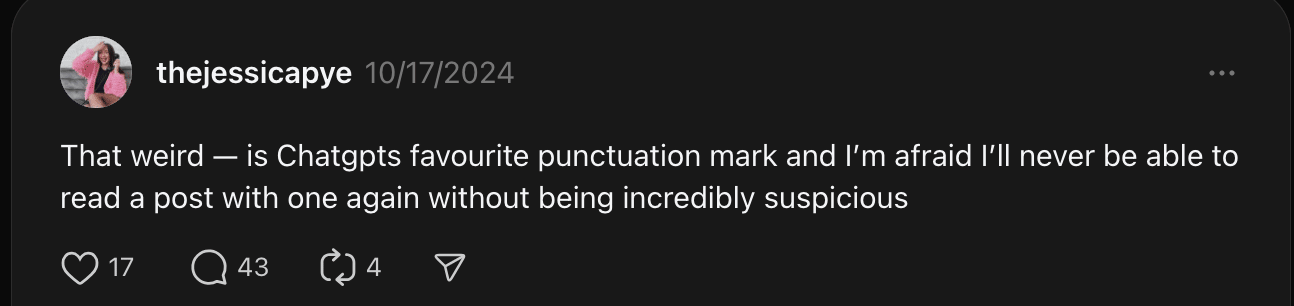
Most casual writers—people who haven’t taken a proofreading or grammar course recently; people who DON’T spend hours of their lives studying writing craft; people who have day jobs; etc.—are unaware that these different types of dashes even exist, let alone how and when to use them.
So I’m going to tell you. I’ll even show you how to make all the different dashes on your keyboard.
The shorty hyphen
This is the basic dash that has its own key on your keyboard. It’s used for hyphenated words, like mother-in-law, hush-hush, or (sorry) Mar-a-Lago. AND THAT’S IT.
The en dash
This is a slightly longer dash that is meant to signify a mid-sentence pause, or offset a parenthetical – only instead of using parentheses, you use the em dash!
In U.S. English, we mostly use the em dash with a space on either side for this purpose.
On a Mac keyboard, <Option> + <-> gets you where you need to go. See? –
On Windows, <Alt> + 0151 should work. The – will appear when you release the <Alt> button.
The em dash
Here’s where it gets tricky. The em dash and the en dash serve the same purpose. The em dash is the longest dash (you can remember this because “m” takes up more width than “n”, and it’s usually used without a space on either end—like this.
The use case depends on whether you’re writing in U.S. or U.K. English, although some U.S. publications prefer the en dash. Personally, I think the em dash – with spaces – looks fine for the internet, but wrong for a manuscript, and most style guides I’ve seen tend to prefer the em dash, no spaces. However, because I’m constantly working in both mediums, I flip-flop on this issue A LOT.
This is why I make style guides for my clients. We’ll talk about those another time.
On a Mac keyboard, <Option> + <Shift> + <-> is the way.
On Windows, it’s <Alt> + 0150.
Pro tip: in your own writing, you need to stop using the hyphen when what you mean is an en/em dash.
Writing is a visual medium. The way the human eye travels across a screen should be part of what you think about when you’re writing for your business – and if your intention is to create a break in the flow of your sentence, a hyphen is just too small to make that clear.
Not to get all Hermione on you here, but it’s also grammatically incorrect. 😇
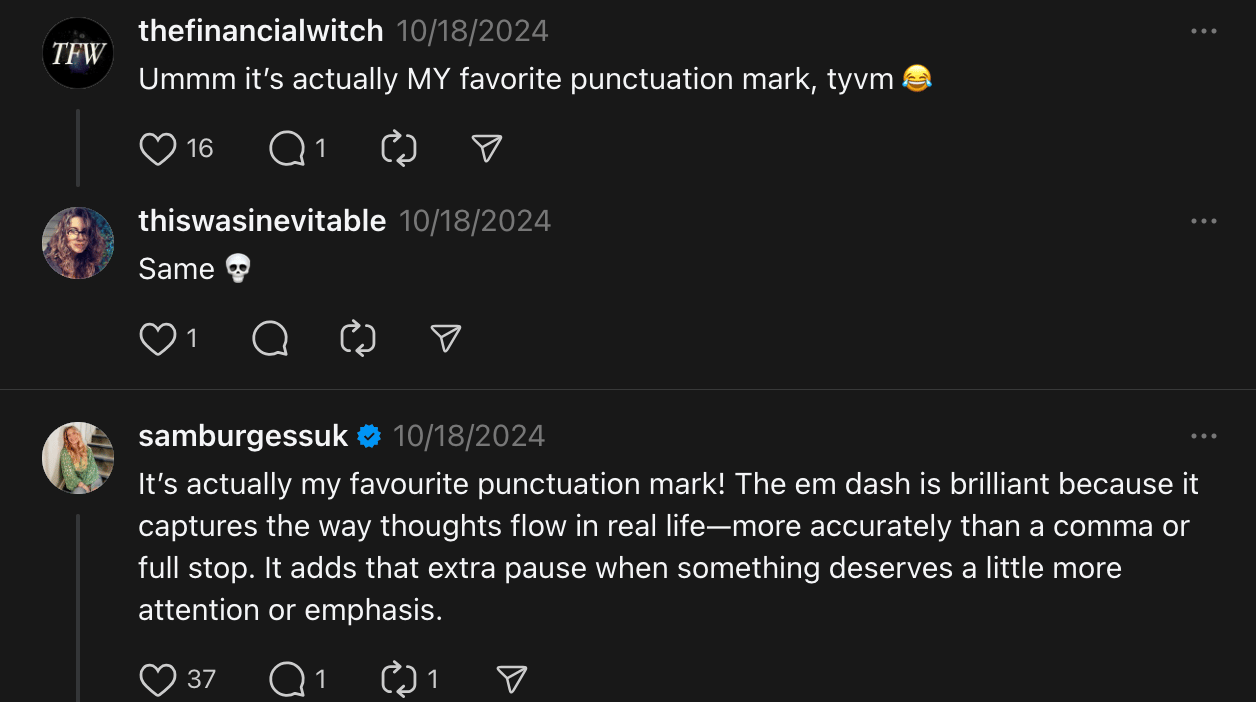
This final comment in the photo above is exactly right: “It [the em dash] adds that extra pause when something deserves a little more attention or emphasis.”
The reason AI likes to use the mn dash with no spaces on either end is because that’s the right way to write these kinds of sentences. If you think it’s “suss,” then you need to read more.
![A screenshot of a comment that reads, "like sorry—you'll have to pry it [the em dash] out of my cold, dead hands](https://images.squarespace-cdn.com/content/v1/6889414203d1a666b7c2a047/d7d481ec-a10a-48fa-80c3-612c26cd1eb9/email.png)
Was this helpful, or do you like it better when I make you mixtapes?